

|
|
|
| Home | | | Surfboards | | | Design | | | Surfing & Media | | | Surfcast | | | About NC | | | Custom Orders | | | Contact |
|
PROFILE & FOIL HISTORY
EVOLUTION & DEVOLUTION |
| |
1966 to 1990
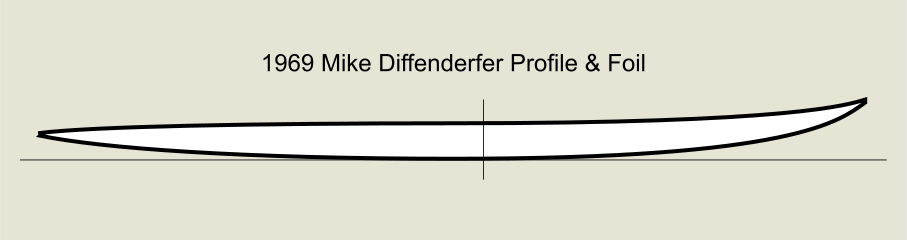
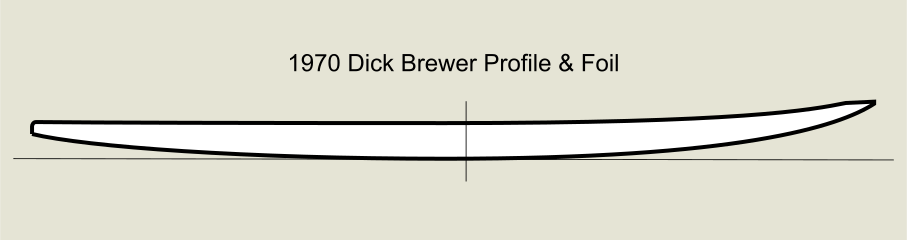
Shortboards date to the second half of the 1960s pioneered by George Greenough, Bob McTavish, Mike Diffenderfer, and Dick Brewer. Greenough's planning hull designs were the first shortboards and opened the door for decades of design evolution and performance surfing evolution. The core principle of Greenough's deigns were their foils. Correct distribution of volume creates a foil and ultimately acceleration, speed, and control. 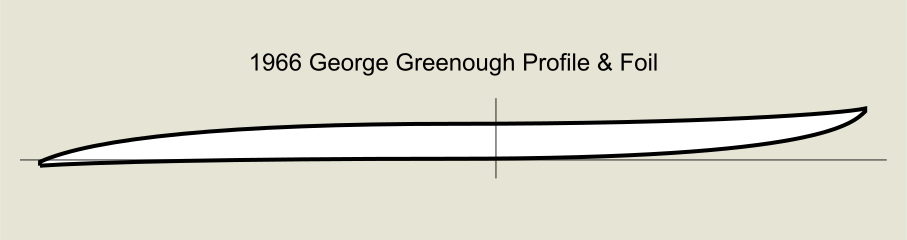 Mike Diffenderfer and Dick Brewer mini gun designs were the next step in
the evolution of surfboard design. Diff and RB developed rockers and profiles
that fit the most critical and powerful sections of waves enabling boards and
surfers to tap into the abundant energy offered by waves. In the late 60's
through the 70s and 80s their foils, profiles, rockers, outlines, and rails
were the ultimate standard in surfboard design. Every design feature in their
boards was foiled, balanced, and synchronized.
Mike Diffenderfer and Dick Brewer mini gun designs were the next step in
the evolution of surfboard design. Diff and RB developed rockers and profiles
that fit the most critical and powerful sections of waves enabling boards and
surfers to tap into the abundant energy offered by waves. In the late 60's
through the 70s and 80s their foils, profiles, rockers, outlines, and rails
were the ultimate standard in surfboard design. Every design feature in their
boards was foiled, balanced, and synchronized.
|
| |
THE GLASS SLIPPER
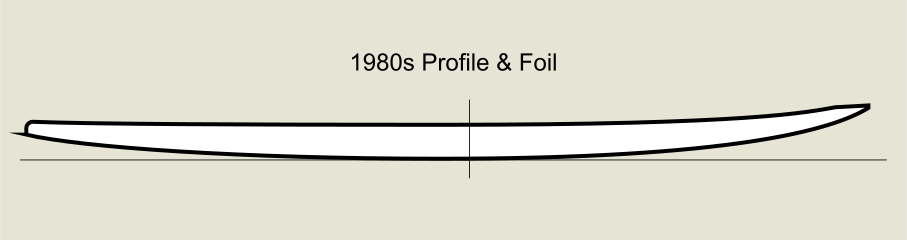
Contemporary high performance shortboard designs date to the late 1980s and early 1990s. These designs were pioneered by the surfers of the Momentum Generation - Shane Dorian, Taylor Knox, Rob Machado, and Kelly Slater, and their Australian peers Taj Burrow and Shane Herring. Prior to that era shortboards were generally high volume designs featuring moderate length, full rails and outlines, and primarily convex bottom contours. The first generation of early contemporary performance shortboards are often refered to as Glass Slippers. They were extremely low volume designs featuring a very narrow outline, a very thin profile and foil, significant banana like rocker with accelerating tail and nose rocker, and deep concave arrays. Early versions of contemporary high performance shortboards - the Glass Slippers - were relatively long, extremely narrow, and extremely thin compared to today's shortboards. Common dimensions were 6' 0" to 6' 2" long x 17 3/4" to 18" wide x 1 7/8" to 2 1/8" thick. The basic distribution of volume was thin in tail, thin at the wide point, and even thinner in the nose. Typically, these profiles were 1/8" to 1/4" thinner 12" from the nose than 12" from the tail, and 1/16" to 1/8" thinner 24" from the nose than 24" from the tail. These designs featured banana like rocker and deep concaves. The relatively thicker back half of the profile and foil was designed to support the surfer with lift from surface area, deep concave array, and moderately foiled profile from wide point to tail. The nose was designed thinner to eliminate the effect of nose volume on the board's performance. These low volume designs remained the prototypical shortboard for 10 to 15 years despite their many limitations. Unfortunately, the Glass Slippers were radically over foiled. Fortunately, the core design features of the Glass Slipper have been the basis for the evolution of the contemporary shortboard. 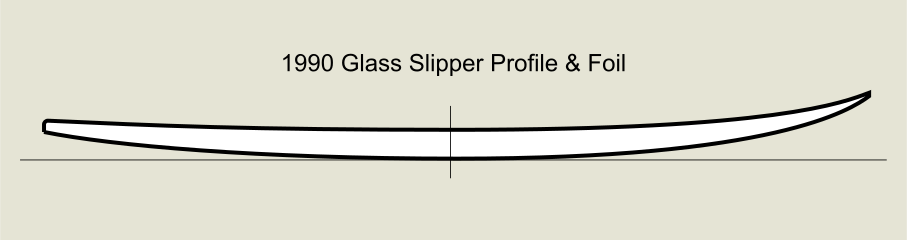 1990 - 2026
The evolution of high performance shortboards from 1990 to 2026 has been dramatic. 21st century surfing and surfboard design has produced progressive - maximum performance shortboards. It has been a truly practical, efficient, and versatile upgrade in surfboard design. This trend to maximum performance shortboards through efficient and versatile designs continues today and should arguably be a constant underlying theme in surfboard design. Design and performance evolved with nuanced rockers, profiles and foils, more surface area in outlines, efficient bottom contours, and tuned rails.
|
| |
|
| |
EVOLUTION & DEVOLUTION of FOILS & PROFILES
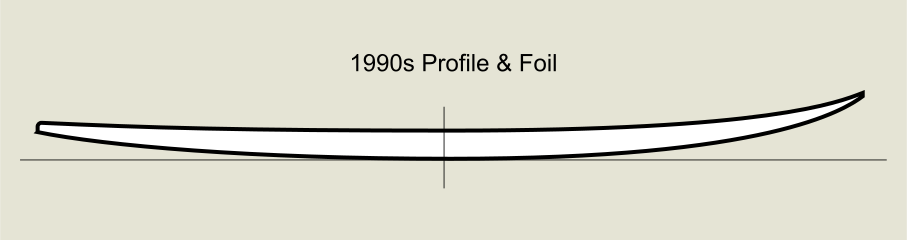
1990 The Glass Slippers were a paradox of evolution and devolution of shortboard designs. The exciting performance features of these low volume designs overshadowed their lack of versatility both in various conditions and across the spectrum of surfer skill. This attraction to the potential for radical surfing combined with extreme rockers, extremely thin profiles and foils, and narrow outlines was like a lead weight on surfboard design and surfing performance for nearly two decades. Performance shortboards of this era were on average 6' 0" to 6' 4" long x 17 3/4" to 18 1/4" wide x 2" to 2 1/4" thick. The distribution of volume in the profile and foil was 1/8" to 1/4" thinner 12" from the nose than 12" from the tail, and 1/16" to 1/8" thinner 24" from the nose than 24" from the tail. |
| |
1990 Foiled Profile 6' 2" x 17 3/4" x 2 1/16" - Original Glass Slipper high performance shortboard distribution of volume, profile, and foil - extreme entry and tail rocker - extremely thin throughout - extremely low volume. |
| |
|
| |
2000
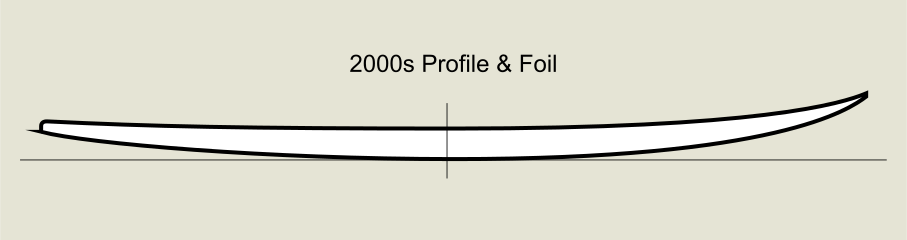
Boards began to get a little shorter, wider, and thicker and featured more nuanced rockers. Concave bottom contours were also moderated and tuned to improve overall performance while maintaining the lift factor they bring to these deigns. Performance shortboards of this era were on average 5' 10" to 6' 0" long x 18 1/2" to 19 1/4" wide x 2 1/4" to 2 3/8" thick. One feature remained the same and that was the distribution of volume in the profile and foil. The profiles and foils were still 1/8" to 1/4" thinner 12" from the nose than 12" from the tail, and 1/16" to 1/8" thinner 24" from the nose than 24" from the tail. These design changes initiated an era of expanded performance range for shortboard designs. Designs were notably more efficient and versatile than their original Glass Slipper predecessors. |
| |
2000 Foiled Profile 6' 1" x 18 1/2" x 2 3/16" - Moderated and nuanced distribution of volume - thicker at widepoint - moderately thicker nose and tail - moderated entry and tail rocker - moderately more volume. |
| |
|
| |
2010
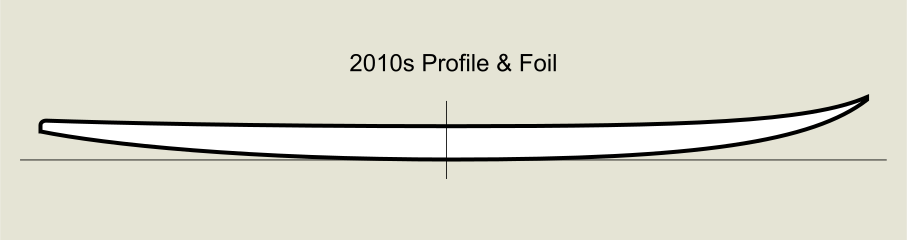
Surfboard design continued trending to improved function and performance and more versatile surfboards. Twenty plus years of design, shaping, and surfing Glass Slipper inspired designs provided surfers and shapers with volumes of observations, feedback, and input to improve performance and versatility of contemporary shortboards compared to the first late 80s early 90s designs. Designs continued to improve performance and versatility across the whole spectrum of surf conditions. Efficient and practical design edits saw boards going marginally shorter, wider, and thicker compared to the previous 10 years. Common dimensions of this era are 5' 8" to 6' 0" long x 18 1/2" to 19 1/4" wide x 2 1/4" to 2 1/2" thick. One element of design that shifted notably is the distribution of volume in the profile and foil. As boards got shorter, more efficient and more versatile it was important to maintain volume or even add some volume to the core of the shape. Shapers started to hide foam in shapes corresponding to the area under a surfer's torso when paddling and stance when riding waves. Outlines also added hidden surface area with the same goal. The center of mass moved slightly forward with these volume and surface area adjustments. The other primary design elements - outlines, rails, and bottom contours, evolved in nuanced sync with rockers, profiles, and foils. |
| |
2010 Foiled Profile 6' 0" x 18 3/4" x 2 5/16" - Continued evolution - nuanced moderation in the distribution of volume - slightly thicker overall - balanced thickness nose and tail - more moderated and nuanced entry and tail rocker - overall moderatley more volume. |
| |
|
| |
2020
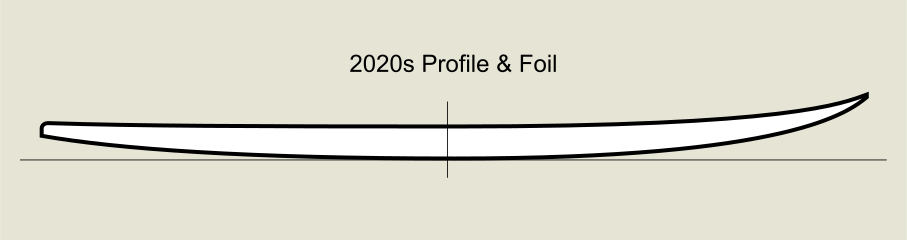
The evolution of high performance shortboards from 2010 to 2020 was a truly practical, efficient, and versatile upgrade in surfboard design. The trend continues today and should arguably be a constant underlying theme in surfboard design. Performance shortboard designs added and shifted a bit more volume and surface area forward. Previously profiles and foils were 1/8" to 3/16" thinner 12" from the nose than 12" from the tail and 3/16" to 1/4" thinner 24" from the nose than 24" from the tail. Shifting volume forward made profiles and foils 1/8" to 3/16" thicker in the nose at 12" than at 24" from the tail and 3/16" to 1/4" thicker in the nose at 24" than at 24" from the tail. Adding and shifting volume and surface area forward was new to the basic all around shortboard, but not new to all designs. Step ups, semi guns, and XXL guns successfully featured hidden volume, equal and sometimes greater thickness in the nose than in the tail, and outlines with the widepoint and surface area shifted forward. When applied to contemporary shortboards this forward shift in the distribution of volume and surface area creates a better more efficient foil thus generating more lift, reducing drag and consequently providing more acceleration and speed. Lift reduces drag, reduction in drag increases acceleration and speed. |
| |
2020 Foiled Profile 5' 11" x 19" x 2 3/8" - Volume shifted forward - moderate thickness throughout - thicker nose relative to tail - moderate entry rocker and lower tail rocker - notably more volume - versatile and efficient design - generates and maintains speed - accelerates on demand. |
| |
|
| |
2026
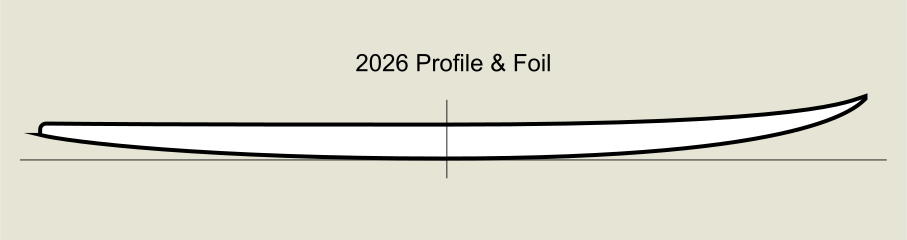
Evolution of shortboard design is a constant. The trend to practical, efficient, and versatile designs continued from 2020 to 2026 with nuanced edits of all design features. Evolving rockers, profiles, and foils offer surfers maximum performance. Design is focused on catching waves, acceleration and projection, speed, maneuverability, control, and predictability. |
| |
2026 Foiled Profile 5' 11" x 19 1/8" x 2 7/16" - Volume shifted forward - moderate thickness throughout - thicker nose relative to tail - slightly lower entry rocker and tail rocker - notably more volume - a practical, efficient, and versatile design - generates and maintains speed - accelerates on demand. |
| |
|
| |
MATCHING VOLUME to SURFERS & DESIGNS
Surfers vary in age, gender, size, skill, fitness, and technique or style. Matching volume to these variables is essential to maximizing the performance of a contemporary shortboard. Correct volume for one surfer may not be correct for another. The Theory of Volume and the Theory of Displacement are principles for surfers and shapers to tune dimensions appropriate volume. |
| |
|
| |
LINKS
Theory of Volume Theory of Displacement |
| |
< top of page > |